
SPONSORED CONTENT
This article was published in partnership with an advertiser.
In a lease takeover, you accept someone else's vehicle and remaining contract. You didn't choose the car when it was new, and you may not know how it was maintained. Before committing, check what you can yourself. Arrange a broader mechanical inspection or professional tire service for concerns you can't assess in a driveway.
SparkLease is an online vehicle marketplace connecting people seeking lease takeovers with available listings in Canada. Don't mistake a listing for an inspection report. For an Ontario takeover, weigh the car's condition against the responsibilities under the remaining lease, including any return standards.
Service records show how the vehicle was treated
Match the records to the maintenance schedule
Rather than taking someone's word that the car was always maintained, ask for dated invoices or digital service records. The vehicle and work completed should both appear in the records. Compare the dates and odometer readings against the maintenance schedule in the owner's manual. Even with few kilometres driven, required intervals may depend on time; when the schedule specifies time and distance, use whichever limit comes first.
Pay attention to oil changes and scheduled inspections. When a warning light prompted a repair, request the invoice describing what the shop found and fixed. A recall is a manufacturer-directed repair for a known safety or compliance issue. Check whether any are still outstanding.
Investigate gaps instead of guessing
A missing record isn't proof that maintenance was skipped. Even so, the current leaseholder should explain the gap and name the shop that completed the work. If needed, request duplicate invoices.
Match the vehicle identification number, or VIN, on the records with the number visible on the vehicle. A receipt for a different vehicle leaves your questions unanswered. Store the documents with your transfer paperwork.
Compare the odometer with the remaining allowance
Calculate the kilometre pace before agreeing
After recording the odometer, find the total allowance and lease-end date in the contract. Subtract the kilometres already driven from the allowance and divide the remainder by the number of months left. That result is your monthly driving budget. Compare that budget with the driving you expect to do.
| Contract detail | What to confirm | Why it matters |
|---|---|---|
| Total allowance | The kilometre limit stated in the original lease | It sets the maximum contract usage before any stated overage charge applies |
| Current reading | The odometer reading on inspection day | It shows how much of the allowance has already been used |
| Time remaining | The confirmed lease-end date | It lets the buyer calculate a realistic monthly kilometre budget |
A 2025 guide from Quebec's Office de la protection du consommateur illustrates a 48-month lease with an 80,000-kilometre allowance and says overage charges may apply when the contract specifies them. That example doesn't set an Ontario rule. Confirm the actual per-kilometre charge and what the lease allowance means with your leasing company.
Professional tire service can uncover hidden lease-return costs
Measure tread rather than judging by appearance
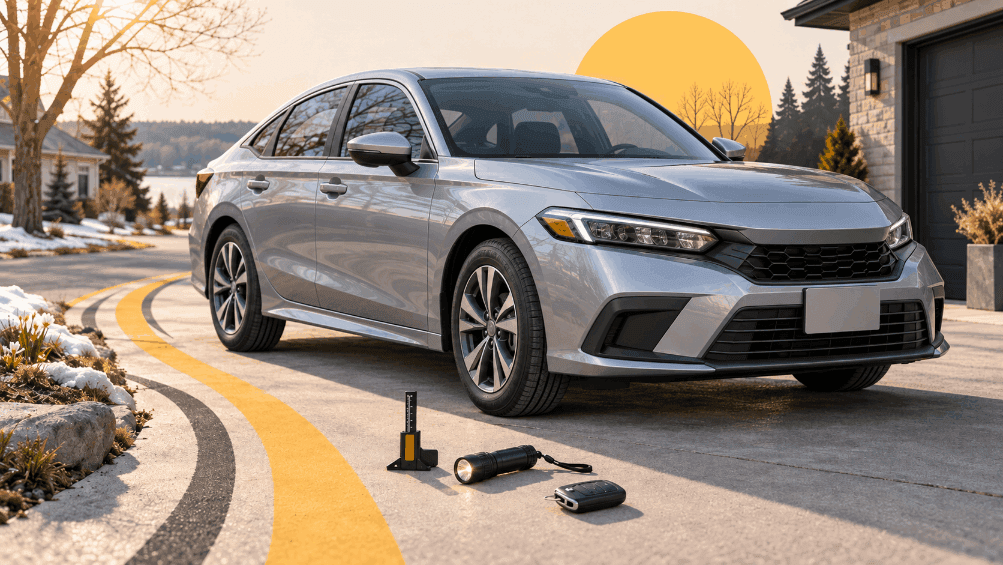
Tread depth is the distance between the top of the rubber tread and the bottom of its main grooves. Use a tread-depth gauge at several points on each tire. Photos won't do. Choose the most worn areas for measurement, not a deep groove that makes the tire look better. Tires worn to the tread-wear indicator, 1.5 mm or 2/32 inch, must be replaced, according to Transport Canada.
CAA reports in its 2025 CAA North & East Ontario guide that Transport Canada recommends replacing winter tires below 4 mm for better grip on snow and ice. That's winter-performance advice, not an Ontario legal threshold or the minimum replacement point.
Read uneven wear as evidence, not a diagnosis
Heavy wear along an edge, in the middle or in isolated patches may suggest incorrect tire pressure or a problem with wheel alignment or suspension. Alignment deals with wheel angles; suspension parts underneath the car support it and absorb bumps. Wear patterns alone aren't a diagnosis. Given Ontario road salt and pothole impacts, you have reason to inspect wheels and suspension components closely.
Before the lease transfer is final, arrange a professional tire service if you can't interpret the tread measurement or wear pattern.